Why outside is better than inside
Every July, the phone rings off the hook at our office because of the heat. Almost always, the conversation immediately turns to air conditioning. And almost never to the windows, even though that is exactly where the heat is coming from.
That is the point where I usually take a moment to explain. Because once you understand what is happening at the window, you can often save yourself the cost of a expensive solution and still keep your house cool.
What really happens at the window
Sunlight is short-wave radiation. Glass lets it pass through almost unhindered. Inside, it strikes floors, furniture, and walls, is absorbed there, and is re-emitted as long-wave thermal radiation. And long-wave radiation cannot get back out through the pane.
This is the greenhouse effect on a small scale, and it is the reason why a conservatory becomes unusable in August.
Therefore, the placement of your sun protection is decisive. If it hangs inside, the radiation has already passed through the glass. The energy is in the room, no matter how thick the material is. Interior blinds absorb it, heat up themselves, and continue to heat the room from within. If the protection is mounted outside, the radiation is intercepted before it hits the glass. The heat is generated outside and carried away by the wind.
The number that matters
In the industry, this is described by the reduction factor, or Fc value for short. It tells you how much of the solar gain remains. The standard values from DIN 4108-2 are clear:
- Interior sun protection, light-colored and low-transmittance: Fc approximately 0.75. This means about three-quarters of the heat remains in the room.
- Exterior blinds, external venetian blinds, or roller shutters: Fc approximately 0.25. About one-quarter remains.
- Exterior awnings and screens, depending on the fabric and angle: Fc between 0.25 and 0.40.
In other words: The difference between an interior blind and an exterior venetian blind on the same window is a factor of about three. That is not just a minor adjustment; that is the difference between a room where you can work and one where you cannot stand to be.
Why air conditioning is the expensive answer
Heat that has already entered the room can only be removed using electricity. An air conditioning unit costs money to purchase, install, operate, and maintain. It requires an outdoor unit that your neighbor can hear, and it runs precisely when electricity is at its most expensive.
External sun protection, on the other hand, only requires a motor that runs for a few seconds a day. It not only lowers the temperature but also protects against glare and the fading of furniture and floors, and it even improves thermal insulation in winter when the roller shutters close at night.
I am not saying that air conditioning is never useful. I am saying: It is the second step. The first step is the window.
Which solution for what
For windows on the facade, venetian blinds, roller shutters, and screens are the means of choice. The external venetian blind is the only one that can do something the others cannot: it directs the light. You adjust the slats so that direct sunlight stays out, while daylight is reflected onto the ceiling. The room remains bright yet cool. Screens are the quiet alternative for large glass surfaces because they run flush with the facade and preserve the view outside.
For patios and balconies, an awning is what it has always been: quickly there when you need it, and gone when you don't. Anyone wanting a fixed solution where rain is no longer an issue will opt for a louvered roof or a glass roof.
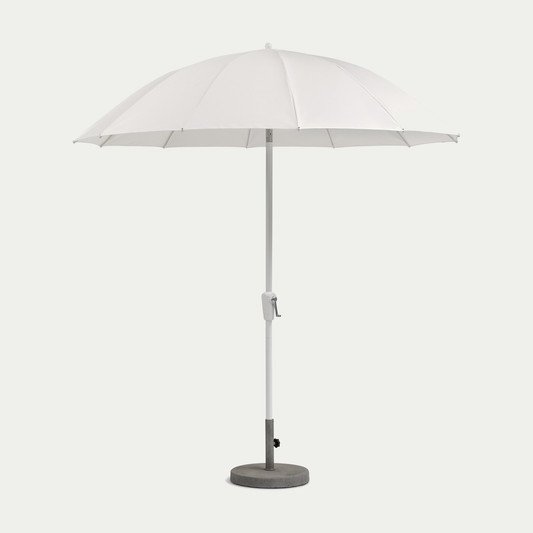
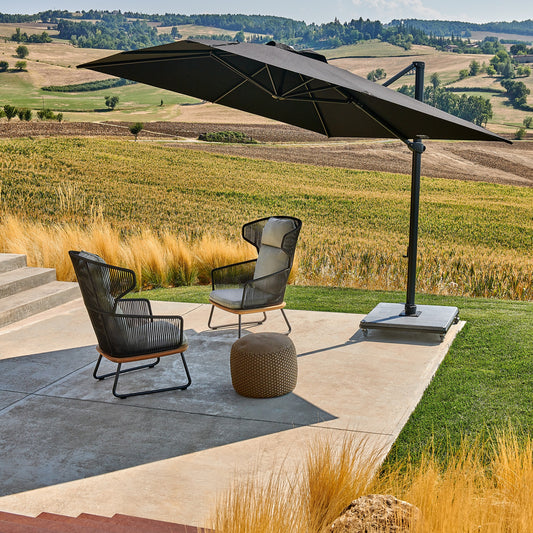
And over the seating area in the garden, where nothing can be attached, a parasol remains the most elegant solution. It is not the weakest option, but often the only one that is actually possible.
When interior is still the right choice
There are cases where exterior is not an option. In a rented apartment, you are usually not allowed to attach anything to the facade. For historic buildings, exterior options are often not approved. And if your goal is privacy in the evening or total blackout in the bedroom, that is a different task than heat protection anyway.
For these cases, there is interior sun protection, and it is the right choice. You just need to know what it can do and what it cannot. It is excellent for glare control. For heat, only to a limited extent.
The best time is in the autumn
This sounds counterintuitive when you are sweating in August, but it is true. In spring, every manufacturer is booked up and delivery times increase. Those who plan in autumn will have a finished system by May, rather than an order stuck in a waiting queue.
If you are not sure what suits your needs, let's look at it together. The orientation, glass area, roof overhang, and existing shading from trees or neighboring buildings matter more than any catalog. Send us a message via the contact form about your project, preferably with a photo of the facade. We will tell you what really helps. And if nothing is necessary, we will tell you that, too.